If you work in pharma, biotech, semiconductor manufacturing, or any space that relies on sterile, low-contamination environments, you’ve probably spent way too much time stressing over HVAC and airflow gear. For years, cleanrooms were dominated by centrifugal blowers and specialized HEPA-certified axial units, but a lot of my regular clients (pharma ops managers, cleanroom design engineers) have hit me up lately asking: “Wait, can fixed axial fans actually work in my space?” Fixed Axial Fans

As a fixed axial fans supplier, I don’t just pitch products— I’ve spent 10+ years troubleshooting this exact question for folks who used to write axial fans off as “too industrial for clean spaces.” Let’s break this down like we’re grabbing coffee and geeking out over airflow specs, no stuffy jargon.
First, let’s clear up the biggest myth: fixed axial fans aren’t just the loud, clunky units hanging in factory loading docks blowing dust around. Modern fixed axial models are built with the same precision and contamination control as any cleanroom-grade gear— you just have to know which specs to prioritize.
Let’s start with what makes a cleanroom tick: it’s not just “low dust”— it’s a standardized air change rate (ACR), pressure differentials between zones (so unfiltered air doesn’t seep into Grade A/B spaces), and consistent laminar or turbulent flow that keeps particles suspended and pulled out, not settled. Centrifugal fans used to be the go-to here because they deliver high static pressure, which is needed to push air through HEPA filters and long duct runs. But fixed axial fans have evolved, and they solve two huge pain points that centrifugal gear doesn’t: cost and energy use.
Wait, don’t hit the back button yet— I know “energy savings” sounds salesy, but let’s do the math quick. A typical cleanroom centrifugal blower can run 8-12 hours a day, with energy bills that eat 15-20% of a small pharma’s HVAC budget. Fixed axial fans, when sized right, use 30-50% less energy because they move air in a straight, efficient line instead of spinning it sideways through a centrifugal casing. That’s real money— money that can go to more important stuff, like raw materials or compliance audits.
But here’s the catch: not all fixed axial fans are cleanroom-approved. Let’s talk non-negotiable specs before we even think about installation. First, particle generation. Cleanrooms can have ISO Class 1 (the strictest, like semiconductor photolithography bays) all the way down to ISO Class 8 (less strict, like warehouse storage for sterile supplies). A fan that sheds particles from its motor housing, blade coatings, or fasteners is a non-starter. Modern fixed axial models for cleanrooms use static-dissipative or ESD (electrostatic discharge)-safe materials— usually aluminum blades with an anodized finish, or food-grade epoxy coatings that don’t flake. Most have sealed, hermetic motors with no exposed copper windings or plastic housings that can off-gas over time. Off-gassing is a big one— if a fan’s motor gives off volatile organic compounds (VOCs) that get trapped in the cleanroom, it can ruin drug batches or contaminate sensitive semiconductor wafers. I’ve seen clients cut corners here: they grabbed a cheap axial fan for a ISO Class 7 space, only to find out the uncoated plastic motor was leaching tiny VOCs that tripped their particle counters. Don’t do that.
Next, airflow and pressure. Let’s get specific: centrifugal fans push air with static pressure, which is great for long ducts, but fixed axial fans deliver high volume flow rates at low static pressure. That means they’re perfect for short duct runs, direct wall mounts, or recirculation loops that don’t need to push air through long HEPA runs. For example, a small ISO Class 5 lab (think quality control testing space) with a 10ft duct run? A fixed axial fan works way better than a centrifugal unit— it moves enough air to hit the required 20 ACR (air changes per hour) and keeps the space pressurized without wasting energy. But if you’re dealing with a 50ft duct run feeding an ISO Class A cleanroom in a drug manufacturing suite? Fixed axial might not cut it for the main supply airflow, but it’s perfect for auxiliary spaces like gowning rooms or pass-through chambers that still need low-contamination airflow. That’s the other key: fixed axial fans aren’t a one-size-fits-all replacement for centrifugal blowers, they’re a great fit for targeted, low-static cleanroom applications.
Wait, let’s talk noise, because cleanrooms also have strict noise guidelines— most pharma and biotech spaces need to stay under 55 dB to keep staff safe and sensitive equipment (like particle counters) from giving false readings. Old axial fans were loud— like 70+ dB, which is basically a lawn mower. But modern fixed axial models have noise-canceling blade profiles and vibration-dampening mounts that bring that down to 45-50 dB, which is standard for most cleanrooms. I’ve installed these in ISO Class 6 cleanrooms where noise is a priority, and clients can’t even tell the fan is running unless they stand right next to it. That’s a game-changer.
Now, let’s get to the compliance stuff, because if you’re in a regulated industry (pharma, medical devices, semis), compliance isn’t optional. A lot of engineers think fixed axial fans can’t pass FDA, GMP, or ISO 14644-1 standards, but that’s outdated. Cleanroom-grade fixed axial fans come with full traceability for materials, third-party particle testing (usually <0.1 micron particle generation, which meets the strictest ISO specs), and validation documentation that auditors actually ask for. I work with a mid-sized biotech that switched 3 of their gowning room fans from centrifugal to fixed axial two years ago, and they sailed through their FDA audit with zero notes on HVAC equipment. That’s not a fluke— it’s because modern fixed axial units are built to the same strict material and testing standards as any other cleanroom gear.
Wait, but what about downsides? No product is perfect. Let’s be real: fixed axial fans aren’t ideal for high-static applications. If your cleanroom has long duct runs, or needs to push air through HEPA filters with high resistance (like ULPA filters for semiconductor fabs), a centrifugal blower is still the way to go. Also, fixed axial fans are less flexible for airflow adjustments— you can’t dial in static pressure as precisely as a centrifugal unit. But for 60-70% of the cleanroom applications I see (auxiliary spaces, small lab suites, short recirculation loops), that flexibility isn’t needed. And if you do need to tweak airflow, most modern fixed axial fans have variable speed drives (VSDs) that let you adjust volume to hit exact ACR requirements, no problem.
Another point: maintenance. Cleanroom equipment needs easy, non-contaminating maintenance, right? Fixed axial fans are way simpler to service than centrifugal units. They have fewer moving parts, so you don’t have to take apart a complex casing just to clean the blades (which is a big plus for avoiding particle contamination during upkeep). Most cleanroom-grade models are designed to be cleaned with IPA or mild disinfectants without damaging the motor or coatings, which cuts down on downtime between maintenance checks. I’ve had clients who used to spend 4 hours a week servicing centrifugal blowers, now spend 45 minutes on fixed axial units— that’s less time out of compliance, more time on other work.
Let’s talk real-world use cases to make this concrete. Last year, a contract manufacturing organization (CMO) that makes injectable drugs hit me up. They had a ISO Class 7 cleanroom for storing raw materials, but their old centrifugal blower was costing them $12,000 a year in energy. We swapped in 4 fixed axial fans for their recirculation loops, adjusted the VSDs to hit their required 15 ACR, and they cut their energy bill by $7,200 that first year. They also did a particle test after installation, and their particle counts stayed well under ISO limits— auditors never flagged it. Another client: a small semiconductor lab doing wafer testing, with an ISO Class 6 space. They needed extra airflow for their test stations, and a centrifugal unit was too big for their limited ceiling space. A wall-mounted fixed axial fan fit perfectly, moved the required 25 ACR, and didn’t add any noise that would mess with their sensitive test equipment.
So, to circle back to the original question: Are fixed axial fans suitable for cleanrooms? The short answer is: Yes, if you pick the right model for your application. They’re not a replacement for centrifugal blowers in high-static, long-duct main airflow systems, but they’re a cost-effective, low-energy, compliant option for auxiliary cleanroom spaces that most people never considered.
Now, if you’re in the market for fans for your cleanroom, don’t just grab the cheapest unit off Amazon. You need to make sure your fixed axial fan is certified for cleanroom use— look for specs like static-dissipative coatings, sealed ESD motors, third-party particle testing, and compliance with ISO 14644-1 or GMP standards. If you’re not sure which size or model fits your specific cleanroom’s ACR, pressure differential, and space constraints, hit me up to chat through your setup.
Don’t waste money on overcomplicated, overpriced centrifugal gear for spaces that don’t need it. Fixed axial fans have come a long way from the industrial units of the past— they’re built to meet strict contamination standards, save you cash on energy, and work perfectly for a huge range of cleanroom applications.
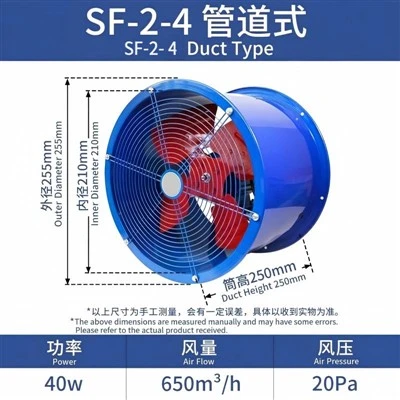
If you’re ready to stop overspending on HVAC and find the right fan for your cleanroom, get in touch to discuss your project details.
Single Stage Regenerative Blowers References:
ISO 14644-1: Cleanrooms and associated controlled environments — Part 1: Classification of air cleanliness by particle concentration
FDA Guide for Industry: Sterile Drug Products Produced by Aseptic Processing — Current Good Manufacturing Practice
ASHRAE Standard 52.2: Method of Testing General Ventilation Air-Cleaning Devices for Removal Efficiency by Particle Size
Taizhou Yijia Electromechanical Co., Ltd.
As one of the most professional fixed axial fans manufacturers and suppliers in China, we also support customized service. Please rest assured to buy high quality fixed axial fans in stock here from our factory. If you have any enquiry about cooperation, please feel free to email us.
Address: No. 47, Jinxing First District, Jintang Village, Jinqing Town, Luqiao District, Taizhou City, Zhejiang Province
E-mail: 826339968@qq.com
WebSite: https://www.yijiablower.com/
