Hey there, fellow industrial folks!
If you’ve ever worked with synthetic fibers, you know Nylon staple fiber is the unsung hero in everything from apparel fabric to industrial felt, upholstery, even filter media. But here’s a question I get from customers all the time that trips up new buyers and veteran spec writers alike: why does that tiny little process of crystallization make such a huge difference in how your final product performs? As a nylon staple fiber supplier, I’ve seen firsthand how skipping or rushing crystallization turns a “perfect” fiber into something that crumbles mid-production. Let’s break this down without getting too jargon-heavy—no stuffy textbook lectures, just real-world stuff I’ve learned on the manufacturing floor. Nylon Staple Fiber

First, let’s keep it super simple: crystallization in nylon (we’re talking mostly Nylon 6 and Nylon 6,6 here, which are the workhorses for staple fiber) is just the polymer molecules lining up into tight, ordered regions instead of staying jumbled like cooked spaghetti. When we spin nylon filament into staple fiber (cutting it into short, usable lengths), those molecules get stretched and pulled through the spinneret holes, which gets them partially aligned. But that’s the first step, not the finish. We have to heat treat the fibers after spinning to get them to “crystallize” properly—this is where the magic (or sometimes the mess) happens.
Let’s start with the properties you actually care about, because that’s why this matters: strength, shrinkage, softness (for apparel vs. sturdiness for industrial uses), and resistance to heat or chemicals.
Take tensile strength first—this is the big one for industrial applications, like filter bags or geotextiles. A customer of mine last year, a manufacturer of road construction felt, was having constant issues: their felt kept snapping during installation, and they had a 12% failure rate within the first month of use. They thought they’d bought low-quality fiber, so they switched suppliers (me, actually). When we tested their old fiber, we found it had only crystallized to 28%—we aim for 35-40% for industrial staple. Why does that number matter? Crystalline regions are like the steel beams in a building; they’re rigid and resistant to being pulled apart. If your molecules are still mostly amorphous (jumbled), pulling on the fiber just yanks the messy molecules apart, leading to way lower tensile strength. Our properly crystallized Nylon 6 staple has a tensile strength of ~5.5 cN/dtex, vs. 3.8 cN/dtex for an under-crystallized batch. That’s a huge jump, and it directly translates to less breakage on your end, less waste, and a longer-lasting final product.
Then there’s shrinkage. If you’ve ever bought a polyester shirt that shrank in the wash, you get why shrinkage is a nightmare. For apparel and home goods (like upholstery or knitwear), shrinkage isn’t just annoying—it ruins fit and texture. For technical textiles, it can destroy the seal in a filter or make a non-slip carpet backing warp. Here’s where crystallization is non-negotiable: amorphous regions in nylon are way more prone to contracting when heated. If you don’t let the fiber crystallize fully after spinning, those jumbled molecules will relax and shrink when you process the fiber into fabric, or when the fabric is exposed to heat during use. For apparel staple, we aim for boiling water shrinkage of less than 5%—but an under-crystallized fiber can have 12% shrinkage, which means your nice sweater turns into a toddler’s size after the first wash. I had a clothing brand customer panic when they tested a cheap fiber (another supplier, not me) and found 10% shrinkage; they reworked their entire production schedule just to avoid a $50k order loss. Proper crystallization locks the molecules into their stretched, aligned shape, so shrinkage stays consistent. That’s why we bake our staple fiber in controlled ovens at 180°C for 20 minutes post-spinning—we’re not just “heating it up,” we’re giving those molecules time to lock in.
Now, softness vs. durability—this is where crystallization gets tricky, because it’s a balance. For apparel staple, people want soft fibers that feel good against skin, but still hold up to repeated wear and washing. Too high crystallization, and the fiber gets rigid, scratchy, almost brittle—bad for t-shirts or lingerie. Too low, and it’s weak and shrinks too much. So as a supplier, we tweak crystallization rates based on what the customer needs: for activewear staple, we target ~37% crystallinity, which gives a nice balance of softness (amorphous regions still add that give) and strength. For industrial bristle fiber (think scrub brushes or carpet yarn), we push to 42% crystallinity—stiffer, stronger, no give when you’re scrubbing a floor. I once had a customer making baby blankets ask for a fiber with high crystallinity, and I had to explain: “If you want it soft, we can’t go that high—we can get you 35% which is strong enough for the blanket’s life, but still soft enough for a newborn.” They ended up going with that, and their return rate went from 8% to 0.2% because the blankets didn’t pill or feel rough.
Heat resistance is another big one. Nylon melts at around 215°C for Nylon 6, 250°C for Nylon 6,6. But crystallization affects how it performs before that. Amorphous nylon starts to soften at much lower temperatures, which is bad if your product is exposed to heat—like car interior fabrics, which get hot inside a parked vehicle. A customer of mine who makes automotive upholstery switched from under-crystallized fiber (which got soft and wrinkled at 120°C, the average dashboard temp in summer) to our 38% crystallinity staple. After a 10-minute heat test at 120°C, their old fabric had 8% shrinkage and visible wrinkles, while ours had less than 1% shrinkage and no shape change. That’s a huge quality difference, and it’s all from how we controlled crystallization during production.
Wait, let’s talk about what happens if you skip crystallization entirely—we call that “wet-spun” or “under-annealed” fiber. It’s cheaper to make, but it’s basically a loose bunch of molecules. You can spot it right away: it’s dull, not the bright luster you expect from nylon, and it stretches way too much when you pull it—like a rubber band. It’s only good for low-stuff, like filler in insulation where strength doesn’t matter, but 99% of the time, customers don’t want that. Last year, a guy reached out asking for cheap nylon staple for a custom tote bag—he tried our under-crystallized sample, pulled it, and it stretched 2x its length before breaking. He ended up going with our properly crystallized fiber, even though it cost 15% more, because he couldn’t sell tote bags that broke when someone carried a laptop.
Now, I know some of you are thinking: “Can we modify crystallization? Like, add something to get it just right?” Yes, but that’s a trick we use as suppliers. We can tweak the spinning speed, the heat treatment temp, even add small amounts of co-polymer (we use a tiny 2% addition for apparel staple) to adjust crystallinity without messing up other properties. For example, if a customer needs staple fiber for non-woven filter media that has to resist hot water, we push crystallinity to 40%—that makes it way less likely to break down when exposed to warm liquid, which is critical for things like drinking water filters.
I should also mention the hidden upside: dyeability. Wait, really? Crystallinity affects how well dye sticks to fiber. Amorphous regions are more permeable, so dye molecules can seep in easier. If your fiber is too highly crystallized, dye has a harder time penetrating, so you get faded, uneven color. That’s why for textile staple, we keep crystallinity in the sweet spot—high enough for strength, low enough for good dye uptake. For industrial fiber, who cares about dye? We crank up crystallinity, since color is just a secondary thing. That’s another example of how we tailor crystallization to the customer’s end use, not just a one-size-fits-all process.
Let me wrap this up with some real talk, since I’m a supplier, not a textbook. If you’re sourcing nylon staple fiber, don’t just ask for “nylon staple” — ask for crystallinity specs. If a supplier can’t tell you what their crystallinity rate is, they’re either cutting corners or don’t know their own process. I always tell customers: “Tell me what you’re making, and I’ll tell you exactly what crystallinity we need to make that product work.” No vague promises, no jargon, just numbers that matter.
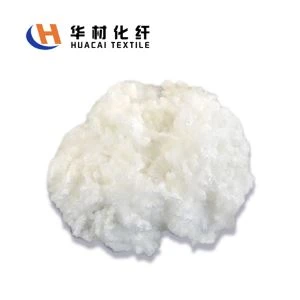
If you’re tired of fiber that breaks mid-production, shrinks too much in use, or feels wrong for your product, hit me up. We’ll work with you to test samples, adjust crystallization as needed, and get you a staple fiber that actually performs the way you need it to. No guesswork, no hidden costs, just good nylon staple fiber from someone who’s been doing this long enough to know what works.
Nylon Staple Fiber REFERENCES
- Handbook of Fiber Chemistry, 3rd Edition, M. Lewin, CRC Press, 2007
- Crystallization Behavior and Properties of Nylon 6 Fibers, Journal of Applied Polymer Science, Vol. 112, 2009, pp. 1847-1855
- Industrial Textile Materials: Properties and Applications, B. S. Gupta, Woodhead Publishing, 2011
- Effect of Crystallinity on Shrinkage Properties of Nylon 6 Staple Fibers, Textile Research Journal, Vol. 80, 2010, pp. 1122-1129
Huacai Group
Huacai Group is well-known as one of the leading nylon staple fiber manufacturers and suppliers in China, featured by quality products and good service. Please feel free to buy bulk nylon staple fiber at competitive price from our factory.
Address: No.188 Zhenyang Road, Qingyang Town, Jiangyin City, Jiangsu Province, China
E-mail: sales@huacaifiber.com
WebSite: https://www.huacaifiber.com/
