Hey everyone, quick heads up before we dive in – I’m part of a team that supplies meters (y’know, the length standard) for everything from construction sites to lab gear, so I’ve spent way more time than I should on why the meter ended up as the go-to for measuring stuff. Let’s cut the boring textbook jargon and get real about this whole standard thing, no stuffy sentences or repeats here. Meters

First off, way back when, people used random stuff to measure length: the length of a king’s foot, a span of your outstretched arm, even how far a donkey could walk in a day. Total mess, right? If a carpenter in Paris used a foot that was 10 inches long and one in London used 12, their buildings would never line up. That’s where the metric system started creeping in, but the first actual meter definition was wild – like, it was supposed to be 1 ten-millionth of the distance from the North Pole to the Equator along a meridian passing through Paris. Can you imagine trying to measure that? Surveyors trekked through mountains and swamps for years to get it, but it still had flaws. Turns out, their math was off by a tiny bit, so the physical meter bar they made (a metal stick locked in a vault in France) wasn’t perfect. It was heavy, easy to scratch, and if it broke, no one knew the exact length to replace it. That’s where I come in – we supply precision meters, and we saw how bad old physical standards were for businesses that need exact measurements every single day.
Fast forward to 1983, and they redefined the meter to something way more reliable: the distance light travels in a vacuum in 1/299,792,458 of a second. Wait, hold on, that’s not just random number – the speed of light is constant, everywhere in the universe. No more messing with mountain surveys or metal sticks. That’s a game-changer for us as a supplier, ‘cause now every meter we make is traceable back to that unchanging light speed number. If a construction company in Tokyo orders a meter from us, it’s exactly the same length as one we ship to a lab in Chicago, no differences, no guesswork. That consistency is why the meter stuck around – you can’t have a global economy if measurement standards are local.
Let’s talk about why other units didn’t take over, just to keep it real. The imperial system (feet, inches, miles) is still used in some places, right? But it’s a pain for math. If you want to convert feet to miles, it’s 5280 feet = 1 mile – that’s a random number. Metric is base 10, so 100 centimeters = 1 meter, 1000 meters = 1 kilometer. Way easier for accounting, engineering, even baking (okay, baking sometimes uses cups, but that’s a whole other thing). Imagine running a factory that makes car parts – if one part is measured in millimeters and another in inches, you’re gonna waste so much time converting and mess up. The meter as the base unit for length eliminates that chaos. We supply meters that are used in all kinds of industries, and every single one of them relies on that base 10 simplicity.
Wait, let’s not gloss over how important trust is here. When a contractor shows up to a job site, they need to know their tape measure (which has a meter mark) isn’t off by a hair. If it’s even 0.1mm wrong, that’s a big problem for a skyscraper. As a meter supplier, we have to make sure every unit we ship is calibrated to that 1983 light speed definition. No cutting corners – if a lab gets a meter from us that’s not accurate, their experiments might be wrong, which could set back research for months. That’s the responsibility we take seriously, and it’s why the meter’s standard status is so crucial: it’s not just a length, it’s a global language everyone understands.
Also, think about tech stuff these days. 3D printing, drone mapping, satellite navigation – all of that uses meters as the base. Your phone’s GPS uses meters to tell you where you are, and it’s all tied back to that light speed definition. If the meter was different, GPS would be way less accurate, like off by hundreds of feet instead of a few yards. That’s not just a convenience, it’s essential for everything from delivering packages to emergency services. We supply meters that even tech companies use for calibrating their devices, so we’re right there in the background making sure all that stuff works.
Let’s address a common question I get from new clients: why not just use something else? Well, other length units are either local, inconsistent, or too tied to old systems. The meter is the only one that’s globally agreed upon, based on a constant natural phenomenon, and easy to use with the rest of the metric system. Even countries that still use imperial officially, like the US, use meters for most industrial, scientific, and medical work. If you’ve gotten a prescription before, the dosage is in grams and millimeters – that’s metric, centered on the meter. Our medical device clients rely on us to supply accurate meters for their equipment, because a wrong measurement there could be life-threatening. That’s a big reason the meter is the standard – it’s used in fields where precision isn’t optional.
Now, a quick tip for anyone who works with measurements: always make sure your meters are traceable. A lot of cheap tape measures at big box stores aren’t calibrated to the global standard – they’re just mass-produced and might be off. That’s where we come in. We don’t sell cheap, flimsy meters. Every unit we supply is tested to meet international standards, so you can trust it for whatever project you’re on. Whether it’s a small home renovation or a massive aerospace project, the meter’s standard status means you can count on it, and we make sure our products live up to that.
Wait, let’s circle back to that old meter bar in France for a sec. I visited a museum once (don’t laugh, I’m a meter nerd) and saw a replica of that original 18th century bar. It was this tiny, thin metal stick, and I was thinking – how did people ever use that as the global standard? If someone dropped it, bent it, scraped it, that was it. No way to get it back to the exact length. The 1983 redefinition fixed that, ‘cause light speed doesn’t change. It’s the same on Mars, on the International Space Station, everywhere. That’s why the meter is gonna stay the standard, not just for now, but way into the future. As we go to space, build bigger buildings, make smaller electronics, we need a standard that doesn’t change, and the meter delivers that.
I know a lot of folks don’t think about measurement standards until something goes wrong. Like, if you order a custom countertop and it’s 2cm too short, that’s a pain, but if it was a whole meter off, that’s a disaster. Our job as a meter supplier is to make sure those kind of mistakes don’t happen. We work with contractors, scientists, engineers, and more, all of whom need reliable length measurements, and the meter is the foundation of that reliability.
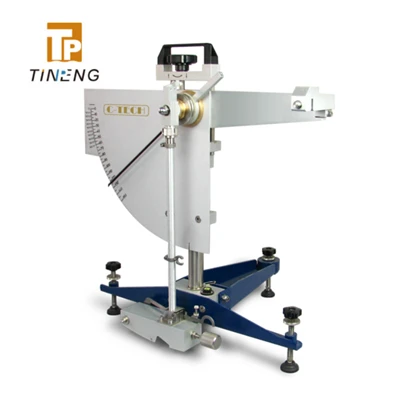
So, to wrap this up: the meter is the standard because it evolved from a messy, local idea to a global, consistent one based on nature. It’s easy to use, works with all the systems we rely on today, and is essential for precision in every industry. If you’re in the market for reliable, traceable meters for your projects, let’s chat. We can walk through what you need, make sure you get the right units that meet your specs, no hassle, no jargon.
Rock and Aggregate Testing Equipment references
- National Institute of Standards and Technology (NIST). "The Evolution of the Length Unit, the Meter."
- International Bureau of Weights and Measures (BIPM). "The International System of Units (SI)."
- History Channel. "The Metric System: How a French Revolution Idea Became Global."
- NASA. "GPS and the Metric System: Precision in Space and on Earth."
Zhuozhou Tianpeng Imp. and Exp. Trade Co., Ltd.
Zhuozhou Tianpeng Imp. and Exp. Trade Co., Ltd. is one of the most professional meters manufacturers and suppliers in China, featured by quality products and good price. Please rest assured to buy advanced meters made in China here from our factory. Customized orders are welcome.
Address: Building C28, Hegu Technology Industrial Park, Development Zone, Zhuozhou, Hebei, China
E-mail: marketing@testmould.com
WebSite: https://www.testmould.net/
